Festival asset tracking · Custody hardware

Stop managing £10k of kit with a £1 clipboard.

The asset office for your event, in a flight case — and it works when the site internet doesn't. Open the lid, power on, scanning. Every issue and return becomes a row in a ledger you own.

£419–£490 — the chargeback for one lost hire radio. support@kitholder.co.uk

KitHolder case open on a production desk, showing a check-in confirmation with green tick
Custody ledger — live ON AIR

The custody argument

Stop paying for losses you can't verify.

Event kit is increasingly vendor-owned — cashless units, entry scanners, hired radios. When the vendor's invoice lands after the build, they charge full RRP for every loss. What's your counter-record? A spreadsheet nobody updated at 1 AM on show day.

// Without KitHolder

The vendor's count is the only record

Whatever their warehouse says came back short, you pay — at full RRP, with no timestamp, no name and no argument to stand on.

LOSS CHARGE · 1 × Radio (full RRP)£419.00

// With KitHolder

You own the ledger

Every movement is a timestamped row — the person, the time, the device that recorded it. A disputed radio becomes a named person and a time, not a line on an invoice.

RAD-0047-KXD · D. Price (Car Park)
OUT 08:12 → IN 22:31 · desk scanner 1

Disputable. Recoverable. Accountable. — one lost radio is the invoice line you'd swallow, vs the ledger row that answers it.

£419+
the chargeback for one lost hire radio, billed at full RRP
< 1 hr
setup on our own network — no venue internet needed
10 yrs
on the circuit — built by crew, from the ops chair
2027
first pilot case planned — first event free

What it is

One flight case. The whole asset office.

Onto the desk, power on, scanning. Everything it needs travels with it — including its own network, clock and certificate authority.

[01]

Workstation

The asset office desk — and the server. Check-out, check-in, live board.

[02]

Its own network

Wired and Wi-Fi. We bring it — a polite guest on site, dependent on nothing.

[03]

Desk scanner

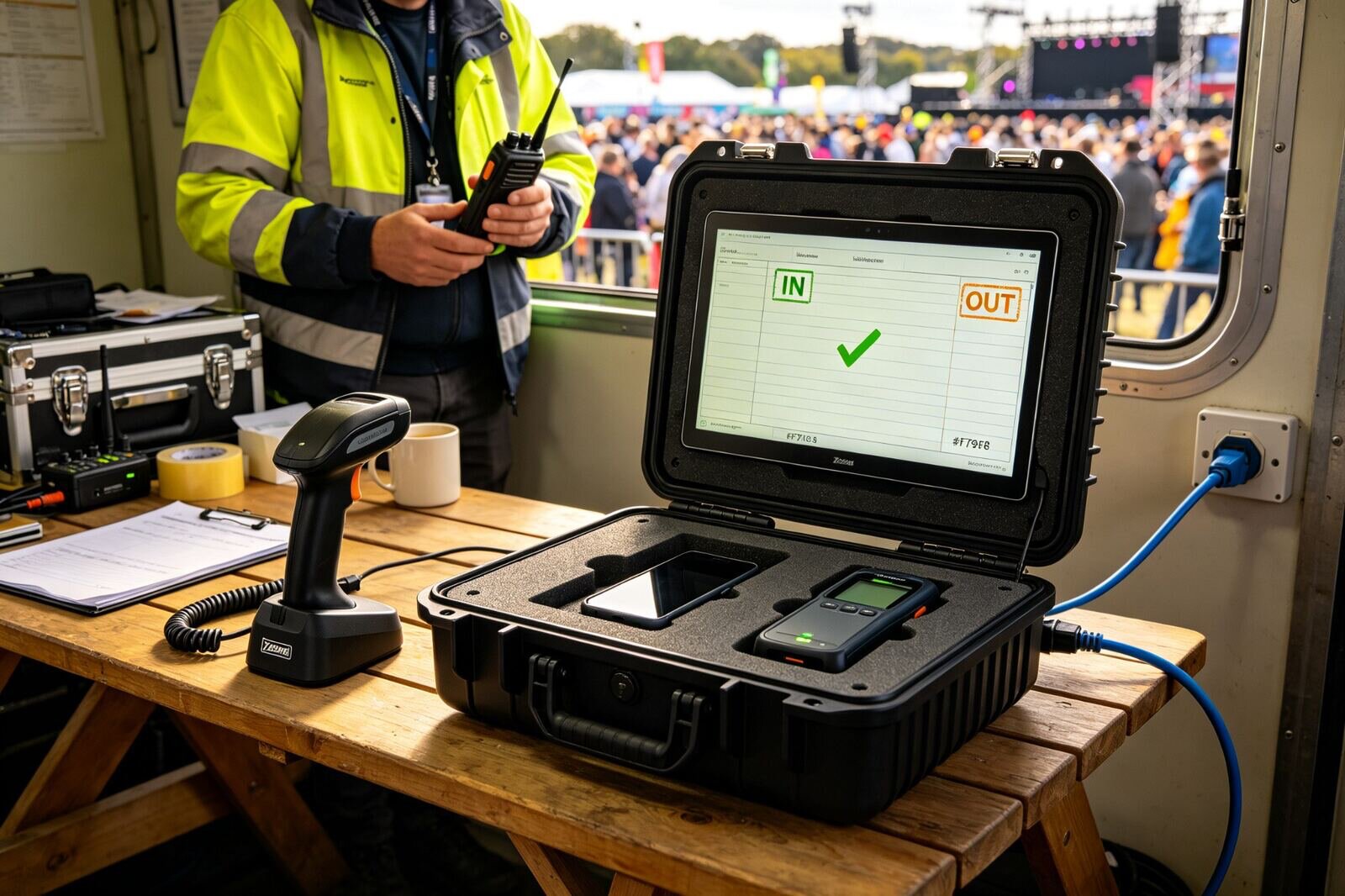
Wired in, self-serve. Scan the radio on the desk; the screen confirms the return.

[04]

Handhelds

Scanners for the window queue and the compound walk.

[05]

Label printer

Every item numbered, labelled and on the register in minutes.

[06]

Backups in the lid

To disk and a USB stick in the lid. Venue internet is treated as unreliable, because it is.

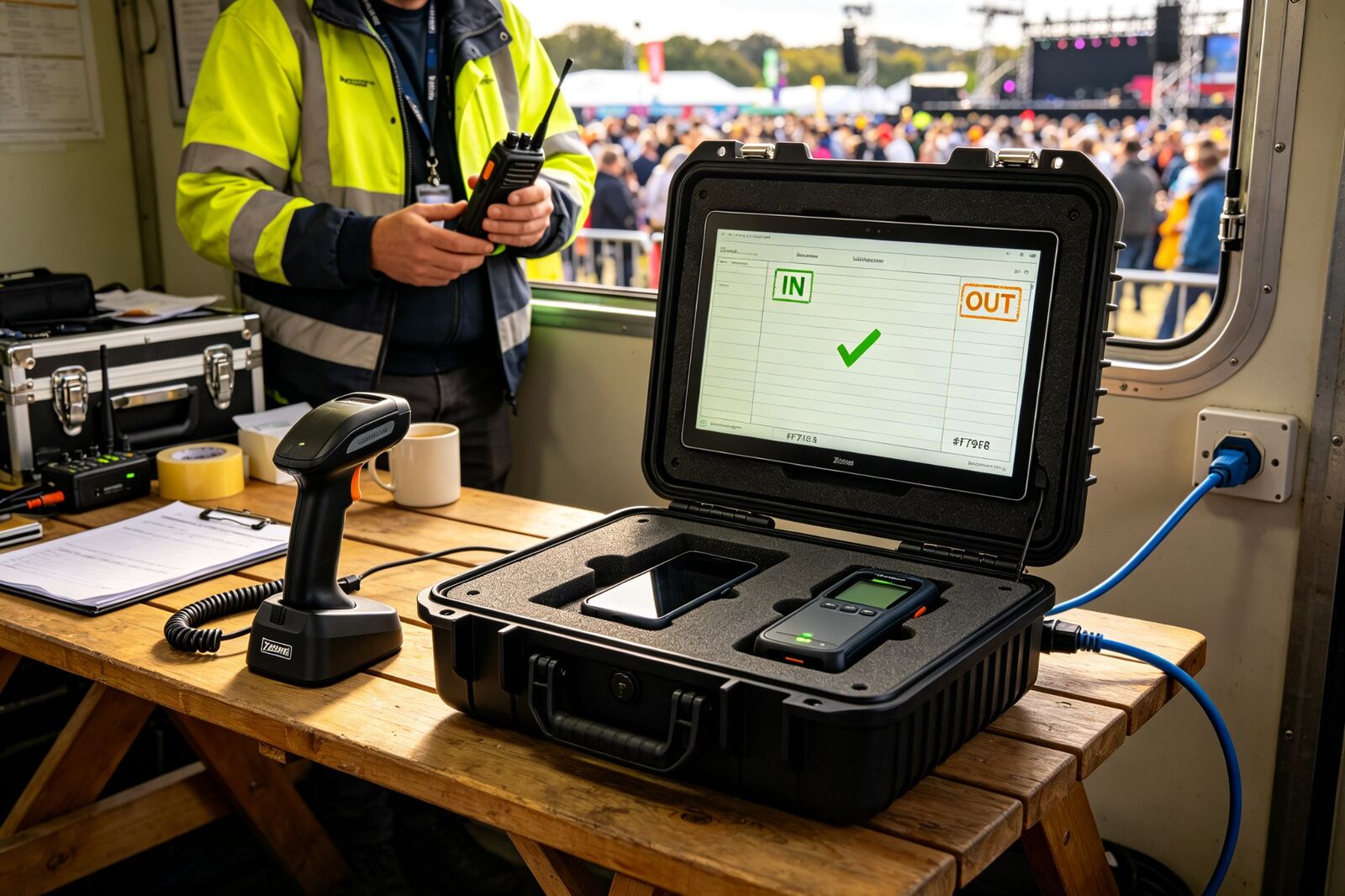
KitHolder flight case opened on a festival production desk with scanner, handheld radio and live IN/OUT board

Why it wins

Five things the spreadsheet never did.

01

The ledger is the evidence

Today the vendor's count is the only record, so a chargeback is undisputable. With KitHolder the organiser holds a timestamped custody chain — append-only, with the person, the time and the device that recorded each movement. At the end of the event the case produces a signed export: who had each item, when, and what came back.

Every scan, on every screen, the second it happens. The signed export is yours to put in front of any hire company.

append-onlysigned exportnamed person + time
02

It runs where festivals actually are

Fully offline by design. Own network, own clock, own certificate authority. Crew phones join the case's own Wi-Fi and run the KitHolder app — no venue internet, no IT ticket, no dependency on the one bar of signal behind the production office.

Backups to disk and a USB stick in the lid. If the site goes dark, the ledger doesn't.

own networkown clockown CAusb in the lid
03

Setup in an hour, by the crew that use it

Built by festival operators, not a software vendor. The desk needs no training: issuing is an admin act — scan the crew badge, scan the radios, done. Returns need no badge and no name check, so the return queue moves fast.

The whole desk reads in colour:

green — checked inblue — out, associatedamber — recorded, caveatred — stop, find a person
04

Honest handling of messy reality

Kit returned that was never issued. A radio still out with someone else. A label that won't read. A scanner set to the wrong mode. Each has a defined outcome and is recorded rather than dropped — anomalies are kept for the office, because they may matter later.

Nothing falls through a gap at 2 AM. Weird cases become ledger rows, not shrugged shoulders.

unmatched return → kept for officeunreadable label → loggedwrong mode → stopped at desk
05

Copy-paste next season

The register, people and teams carry forward. The case comes out of storage pre-loaded — same kit list, same crew, same vendors — with a ten-year certificate that never needs renewing.

Year two starts where year one left off. Storage to scanning in minutes.

register carries forward10-yr certificatepre-loaded case

The workflow

Check-out is a decision. Check-in is self-service.

Two scans at the desk: one says who, one says what. Everything else is an automated timestamp.

A

Crew scans personal QR

The QR on their phone identifies them. The system knows exactly who is standing at the desk. ID · J. Okafor

B

Association: link device(s) to the holder

Scan the radio, scanner or key fob — or several — and each one is associated to that person. ASSOCIATE DEVICE(S)…

C

Confirmation — out, associated

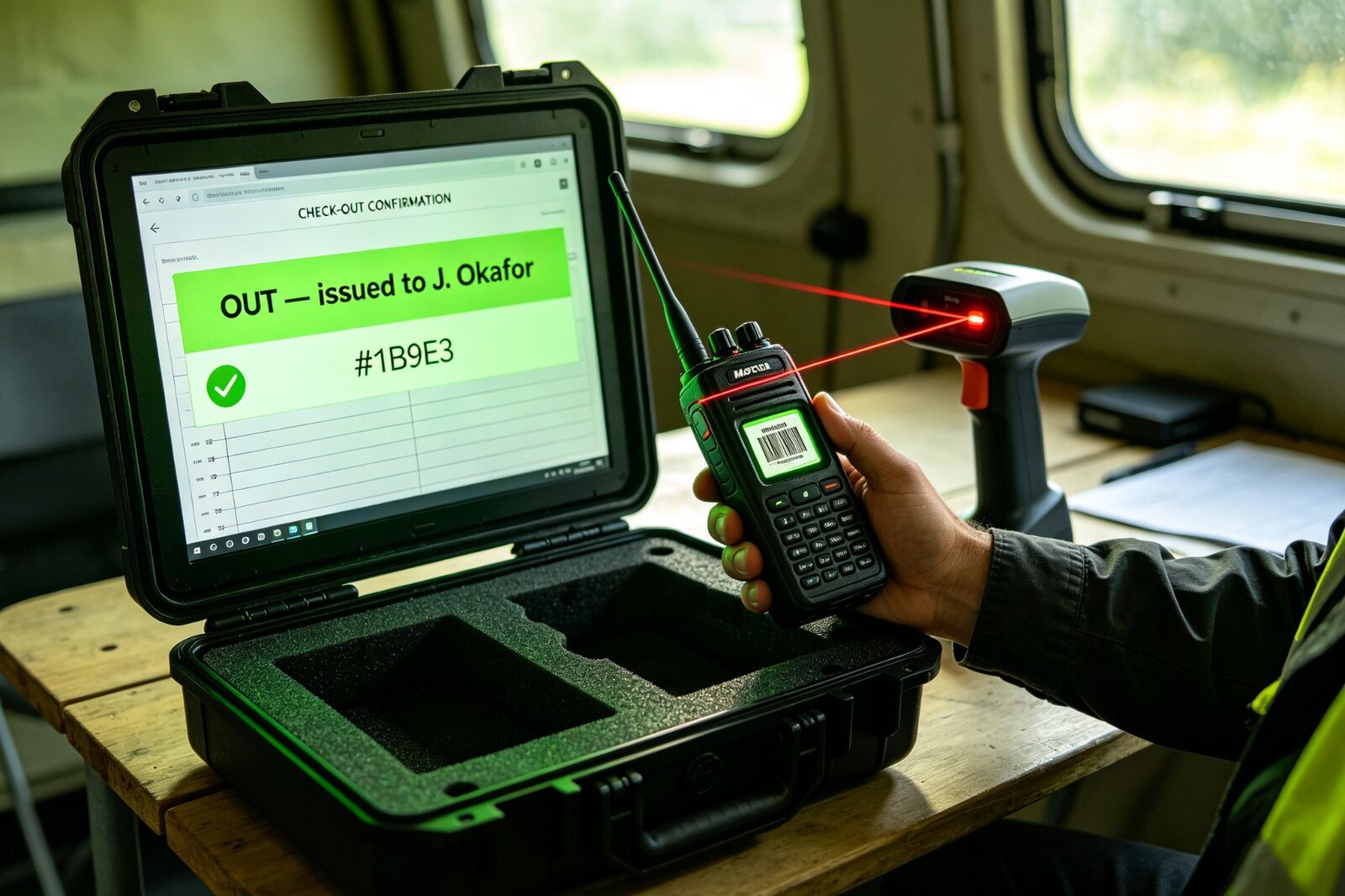
Issued, timestamped, and live on every screen in the room the second it happens. OUT — issued to J. Okafor

D

Return: self-check-in at the desk

Coming back, crew hold the radio under the desk scanner. The screen shows who had it, since when — and a green tick. No badge, no name check, no queue at one person's elbow. Your admin does something more useful.

E

Signed export at the end

The case produces the custody record: who had each item, when, and what came back. Yours. Defensible.

Radio being scanned at check-out with laser and green confirmation on screen
CHECK-OUT · desk scan · #1B9E3
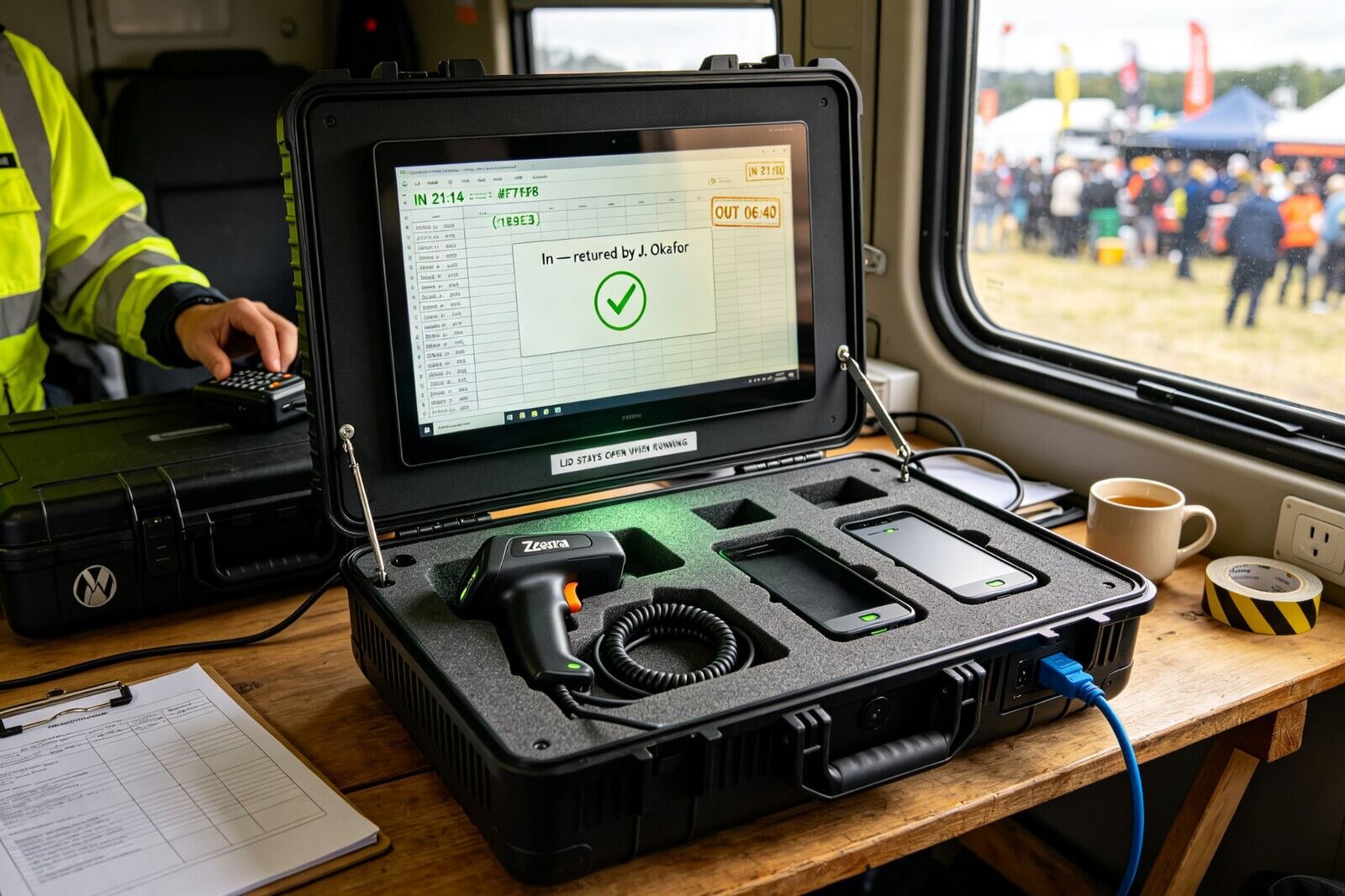
KitHolder case by the production office window overlooking the festival site
PRODUCTION DESK · LIVE BOARD · IN 21:14 / OUT 06:40
kitholder · custody ledger · terminal

Messy reality, defined outcomes

Nothing gets dropped at 2 AM.

// returned, never issued

Kit you didn't send out comes back

Recorded as an unmatched return and kept for the office. It may be last season's, the vendor's, or someone's personal kit — now it's on the record either way.

// still out with someone else

A radio returns while flagged to another person

The desk shows both custody rows and reconciles against the badge scan. Amber — recorded with the caveat, never silently overwritten.

// label won't read

Barcode damaged, wet or torn

The scan is logged as unreadable, the item is flagged, and the label printer re-issues a number. The ledger never skips a beat.

// scanner in the wrong mode

Hardware misconfigured mid-show

The desk rejects the mode change and shows red: stop and find a person. Bad data is stopped before it becomes someone's problem in November.

// green means done

Crew read the desk in one colour

No training deck, no manual. Green means recorded — put it in the case and walk away.

// anomalies kept for the office

Weird cases are evidence too

Every amber and red is retained in the ledger, because a messy row in August can be the answer to a disputed invoice in October.
How it lands

Running before the kettle boils. Nearly.

No installation project, no IT ticket, no specialist operator.

[01]

Set up in an hour

Flight case onto the desk, power on, scanning — on our own network, with or without site internet.

[02]

Admin controls out. Crew handles back.

Your admin decides who takes what out; returns run themselves at the desk scanner.

[03]

Staff portal on their own desks

Anyone on the admin network can look up who has what, from their own machine — live, the second it's scanned.

[04]

Copy-paste next season

Year 2 starts pre-loaded: your kit register, vendors and crew, ready on day one.

The maths

Calculate your lost kit ROI.

Festivals lose 3–6% of fleet kit per event, charged back at full RRP. Put your own numbers in.

Estimated loss bill: £2,514 per event.

The Station costs £795. One event pays for it three times over.

Loss figures from published UK hire terms and dealer RRP, August 2026. Estimate only.

Pricing

Priced like the event, not like software.

Per event, self-setup, everything included. No seats, no annual licence. Launch pricing for the 2027 season.

Up to 100 assets

The Box

£395 / event

Software, desk scanner and label roll, posted ahead. Runs on your own laptop and phones. Set up yourself in under an hour.

Typical loss bill at this size: £420–£980

500+ assets / multi-department

The Office

from £1,750 / event

Station plus additional handhelds and setup support, per department or site-wide. Quoted to the operation.

Typical loss bill at this size: £3,800–£8,800+

Running several events a year? Season terms for agencies and multi-event operators — your kit register, vendors and crew carried from event to event, ready on day one.

support@kitholder.co.uk →

Anchor maths: festivals lose 3–6% of fleet kit per event, charged back at full RRP. Every tier prices below the typical loss bill it prevents. And the first event is free — see below.

The offer

Give us one event.

We're launching for the 2027 season. First event free, in exchange for a case study. If our end-of-show loss report doesn't justify the price of the system, you'll have the exact data you need to prove it.

or email support@kitholder.co.uk